Measuring ingredients accurately is essential for successful cooking and baking. In many recipes, the amounts of ingredients are listed in both ounces and cups. Ounces and cups are both units of measurement commonly used in cooking and baking, but they measure different things. Ounces measure weight, while cups measure volume.
When it comes to measuring ounces with cups, it’s not as straightforward as it may seem. This is because the weight of an ingredient in ounces can vary depending on its density. For example, a cup of flour will weigh less than a cup of sugar, even though they both occupy the same volume.
However, there are some general guidelines that can help you convert ounces to cups, depending on the ingredient being measured.
- Liquids When measuring liquids, such as water, milk, or oil, it’s easiest to use a liquid measuring cup. These cups are designed with a spout for easy pouring and are marked with lines indicating the volume of liquid. One cup is equivalent to 8 fluid ounces. Therefore, if a recipe calls for 16 fluid ounces of milk, you will need 2 cups of milk.
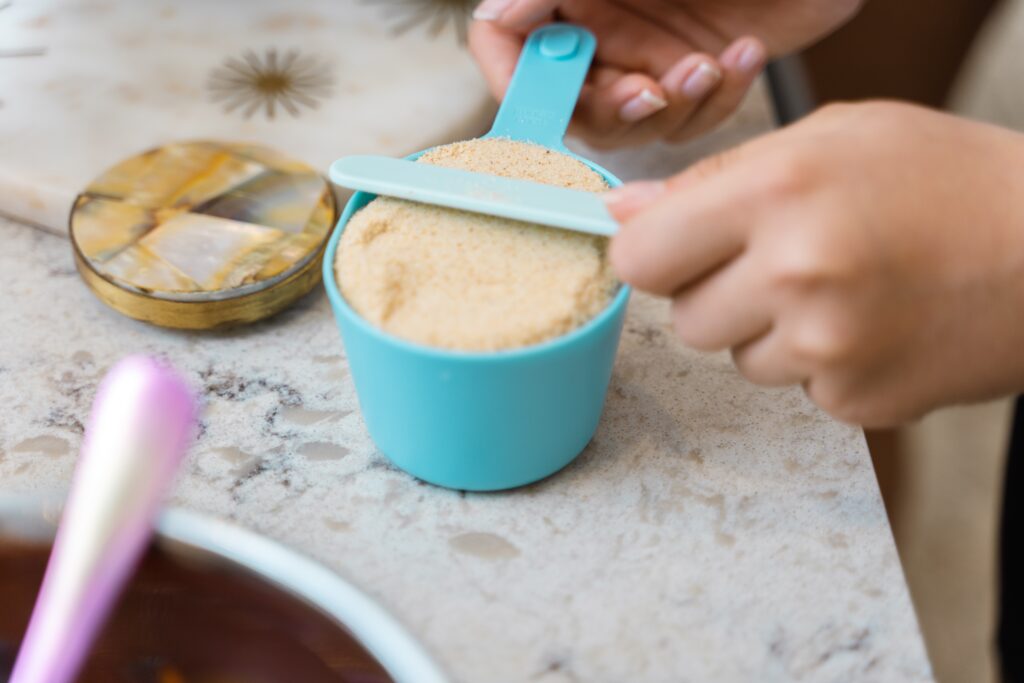
- Dry ingredients When measuring dry ingredients, such as flour, sugar, or cocoa powder, it’s important to use the correct measuring cup. Dry measuring cups are designed to be filled to the top, then leveled off with a straight edge. One cup of all-purpose flour weighs approximately 4.5 ounces. Therefore, if a recipe calls for 8 ounces of flour, you will need approximately 1.78 cups of flour.
- Non-fluid ingredients For ingredients that are not liquids, but not quite dry, such as shredded cheese or chopped nuts, it’s best to use a kitchen scale to measure the weight in ounces. However, if a kitchen scale is not available, you can use measuring cups as a rough estimate. For example, one cup of shredded cheese weighs approximately 4 ounces. Therefore, if a recipe calls for 8 ounces of shredded cheese, you will need approximately 2 cups of cheese.
It’s important to note that these conversions are estimates, and the exact amount needed may vary depending on the ingredient and its density. For this reason, it’s always best to use a kitchen scale when precise measurements are necessary.
In conclusion, while it is possible to measure ounces with cups, it is not always accurate. Converting between volume and weight measurements requires careful consideration of the specific ingredient being measured. It is recommended to use a kitchen scale for the most precise measurements. However, if a kitchen scale is not available, using measuring cups can provide a rough estimate of the amount of an ingredient needed.