Eggs are not just for breakfast; they can be the centerpiece of some fascinating experiments! Whether you’re a teacher looking for engaging activities or a parent wanting to spice up a weekend at home, these egg experiments are perfect for sparking curiosity and creativity in all ages.
From demonstrating the wonders of buoyancy to exploring chemical reactions, these experiments provide a hands-on learning experience that is both educational and entertaining. Get ready to roll up your sleeves and crack open a world of scientific discovery!
Eggs can be a source of fun and learning, involving science principles like osmosis, density, and chemical reactions. Plus, the surprising results will delight kids and adults alike!
Experiments with a Twist
Eggs can surprise us in numerous ways, making them ideal for hands-on experiments.
From a simple bouncing egg to colorful designs, these activities are both entertaining and educational.
The reactions between eggs and various solutions often lead to surprising results that captivate participants of all ages.
The Bouncing Egg Experiment
One of the most fascinating experiments involves placing a raw egg in vinegar.
After a day of soaking, the eggshell dissolves, leaving behind a soft and bouncy egg.
This transformation showcases the concept of chemical reactions, as the acetic acid in the vinegar interacts with the calcium carbonate in the shell.
Participants can gently bounce the egg on a soft surface, marveling at its resilience.
This simple experiment sparks curiosity about the changes the egg undergoes, inviting discussions about the science behind it.
Colorful Egg Creations
Another exciting experiment allows for creativity through color.
By mixing water with food coloring, participants can soak raw eggs to create vibrant, dyed results.
This process is not only visually appealing but also serves as an introduction to concepts like diffusion and osmosis.
Once the eggs are dyed and dried, they can be displayed as colorful creations.
This activity opens the door for further exploration, encouraging participants to experiment with different colors and techniques.
The Float Test
Testing buoyancy can be a fun and educational experience.
By filling two containers with water—one plain and the other saturated with salt—participants can observe how an egg behaves in each.
The egg will sink in regular water but float in the saltwater, demonstrating the principles of density and buoyancy.
This simple experiment allows for discussions about why some objects float while others sink, fostering a deeper understanding of scientific principles.
Engaging Science Supplies
The atmosphere of these experiments can be enhanced with an array of science supplies.
Measuring cups, spoons, and colorful liquids add an engaging touch to the learning environment.
Having these tools readily available encourages participants to take charge of their experiments and explore different variables.
Creating a playful atmosphere can inspire creativity and excitement.
Participants can enjoy the hands-on experience while also being motivated to ask questions and seek answers.
Learning Through Play
These egg experiments provide a perfect opportunity for playful learning.
Each activity encourages curiosity, creativity, and scientific inquiry.
Participants not only learn about scientific concepts but also develop critical thinking skills as they hypothesize and observe outcomes.
With simple materials and easy-to-follow instructions, anyone can explore the exciting world of egg experiments.
These hands-on activities foster a love for science that can last a lifetime.
Egg-citing Experiments to Try
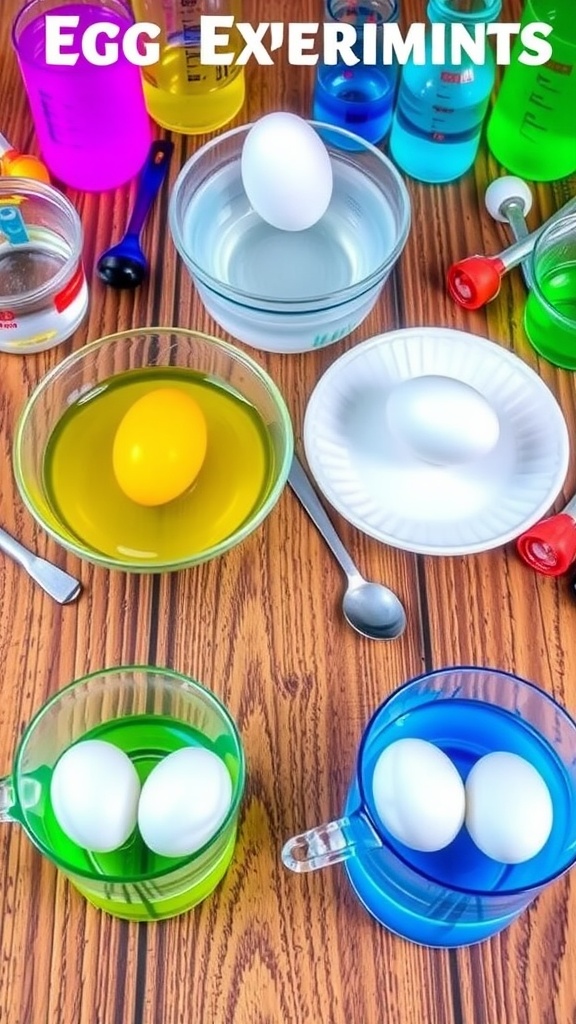
These egg experiments range from simple tasks like making an egg bounce to more complex activities involving vinegar and osmosis. Perfect for a rainy day, they will keep everyone intrigued with their unexpected outcomes.
Ingredients
- Raw eggs
- Vinegar
- Salt
- Water
- Food coloring (optional)
- Bowl or container
- Measuring cups
- Spoon
Instructions
- Bouncing Egg: Place a raw egg in a cup and cover it completely with vinegar. Let it sit for 24 hours. The eggshell will dissolve, leaving a soft, bouncy egg.
- Colorful Eggs: In a bowl, mix water with food coloring and soak a raw egg in the mixture. After a few hours, remove it and let it dry for a colorful result.
- Saltwater Egg: Fill two containers with water. Add salt to one until it’s saturated. Carefully place a raw egg in both. Observe how the egg floats in the saltwater but sinks in plain water.
Cook and Prep Times
- Prep Time: 5 minutes
- Experiment Time: 24 hours (for some experiments)
- Total Time: Varies by experiment
- Servings: N/A
- Calories: N/A
- Fat: N/A
- Protein: N/A
- Carbohydrates: N/A
Related
- Fun and Educational Egg Experiments for Kids
- Fun Yeast Experiments for Kids
- Fun Yeast Experiments for Preschoolers
- DIY Play Dough Mat for Number Learning