Octopuses are intriguing and unique creatures with many fascinating traits. One of the most intriguing aspects of octopuses is their complex nervous system, which includes a decentralized brain. However, contrary to popular belief, octopuses do not have nine brains. Instead, they have a distributed nervous system with a central brain and multiple smaller ganglia, which serve as localized processing centers. In this article, we will explore the anatomy and function of octopus nervous system and clarify the misconception about their brains.
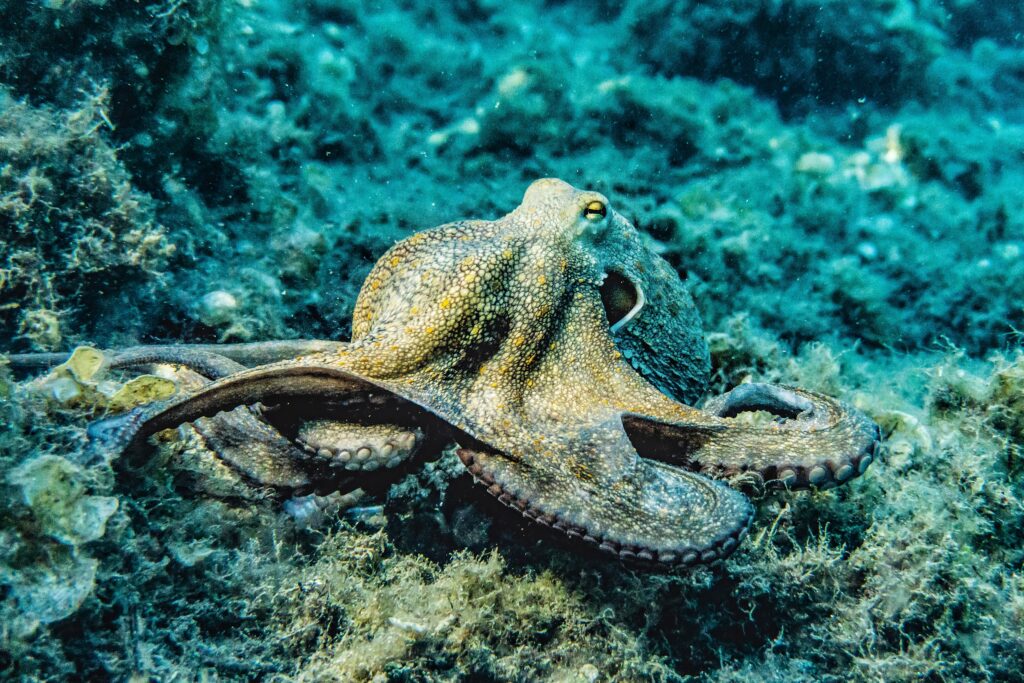
Octopuses belong to a group of animals called cephalopods, which also includes squids and cuttlefish. Cephalopods have the most advanced nervous system among all invertebrates. The octopus nervous system is distributed throughout their body, with the majority of the neurons located in their arms. In fact, more than half of the octopus’s neurons are found in their arms, which are capable of complex movements, remarkable camouflage, and intricate sensory perception.
Octopuses have a central brain located in their head, which is connected to their eyes, and receives visual input. This central brain is responsible for coordinating the octopus’s movements, regulating physiological processes, and processing sensory information from the eyes and other sensory organs. It also plays a role in learning and memory.
In addition to the central brain, octopuses have multiple smaller ganglia or clusters of neurons, which are located throughout their body, particularly in their arms. These ganglia allow for local processing and control of the arms, which are semi-autonomous and capable of independent movements. Each arm of the octopus has its own sensory neurons, motor neurons, and ganglia, which allow it to process information and make decisions on its own. This distributed nervous system enables the octopus to exhibit complex behaviors, such as manipulating objects, capturing prey, and escaping from predators.
The ganglia in the octopus arms are interconnected and communicate with the central brain, allowing for coordination and integration of information. This distributed nervous system allows octopuses to exhibit remarkable flexibility and adaptability in their movements and behaviors. For example, an octopus can change the color, pattern, and texture of its skin to blend in with its environment and avoid detection. This complex camouflage ability is made possible by the coordination between the central brain and the ganglia in the arms, which work together to control the octopus’s body and arms in response to changing environmental cues.
Furthermore, octopuses are capable of learning and memory, which involve complex neural processes. Studies have shown that octopuses are capable of learning through observational and associative learning, and they can remember learned behaviors for extended periods of time. The central brain plays a crucial role in these learning and memory processes, while the ganglia in the arms also contribute to local sensory processing and learning.
It is important to note that while octopuses have a distributed nervous system with multiple ganglia, they do not have distinct “brains” in each of their arms. The term “nine brains” is a misnomer that has been perpetuated in popular culture but is not scientifically accurate. The ganglia in the arms are localized processing centers that work in coordination with the central brain to control the octopus’s movements, sensory perception, and behavior.
In conclusion, octopuses have a distributed nervous system with a central brain and multiple ganglia located in their arms. While these ganglia allow for local processing and control, they do not constitute separate brains. The central brain plays a crucial role in coordinating the octopus’s movements, regulating physiological processes, and processing sensory information, while the ganglia in the arms contribute to local sensory processing and motor control. Octopuses are remarkable creatures with complex nervous systems that enable them to exhibit extraordinary behaviors, but the notion of them having nine brains is a