Military jets have the capability to break the sound barrier, which is also known as supersonic speed. The sound barrier is defined as the point at which an object travels at or above the speed of sound, which is approximately 768 miles per hour or 1,236 kilometers per hour at sea level and 68 degrees Fahrenheit. When an object breaks the sound barrier, it creates a shockwave that can be heard as a loud sonic boom.
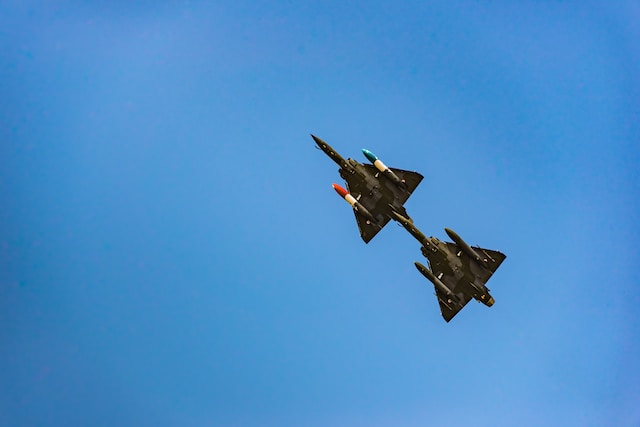
Breaking the sound barrier was once considered impossible. In the early 1940s, aircraft designers believed that an airplane would disintegrate when it reached the speed of sound due to the shockwave created by the aircraft’s nose. However, in 1947, Captain Charles “Chuck” Yeager became the first person to fly faster than the speed of sound in an experimental aircraft called the Bell X-1. Since then, military jets have been designed to break the sound barrier and fly at supersonic speeds.
The ability to fly at supersonic speeds is crucial for military jets as it enables them to travel long distances quickly and reach their targets faster. Military jets that can break the sound barrier include the F-15 Eagle, F-16 Fighting Falcon, F/A-18 Hornet, and F-22 Raptor. These jets are designed to withstand the forces generated by supersonic flight and have advanced avionics systems that allow pilots to navigate and control the aircraft at high speeds.
To break the sound barrier, a military jet must accelerate to supersonic speed, which is typically done by flying the aircraft at a high altitude and then diving towards the ground. As the aircraft gains speed, the pilot must carefully control the aircraft to prevent it from becoming unstable or going out of control.
Once the aircraft reaches supersonic speed, it creates a shockwave that can be heard on the ground as a loud sonic boom. The sonic boom is caused by the compression of air molecules as they are forced together by the aircraft’s nose. The shockwave travels through the air as a cone-shaped wave and is heard as a loud boom when it reaches the ground.
The sound of a sonic boom can be startling and may cause damage to buildings and windows. For this reason, military jets are typically not allowed to fly at supersonic speeds over populated areas. Instead, they are required to fly at subsonic speeds until they reach designated areas where they can safely fly at supersonic speeds.
Supersonic flight also generates other unique challenges for military jets. One of the most significant challenges is the amount of heat generated by the aircraft as it moves through the air. At supersonic speeds, the air molecules are compressed and heated by the aircraft’s nose, which can cause the temperature of the aircraft’s skin to rise significantly. To combat this, military jets are typically designed with advanced cooling systems that can dissipate heat quickly and efficiently.
Another challenge of supersonic flight is the amount of fuel required to maintain high speeds. Military jets that fly at supersonic speeds consume a significant amount of fuel, which can limit their range and endurance. To address this, some military jets are designed with advanced engines that are more fuel-efficient at high speeds.
In conclusion, military jets have the capability to break the sound barrier and fly at supersonic speeds, which is essential for military operations as it enables jets to travel long distances quickly and reach their targets faster. However, supersonic flight presents unique challenges, such as generating a loud sonic boom and requiring advanced cooling systems and fuel-efficient engines. Despite these challenges, military jets will continue to push the limits of supersonic flight as technology advances and new capabilities are developed. The ability to break the sound barrier is a testament to human ingenuity and determination to push beyond the boundaries of what was once considered impossible.