Yes, America has bullet trains, although the technology is not as widespread or advanced as it is in some other countries, such as Japan, France, or China.
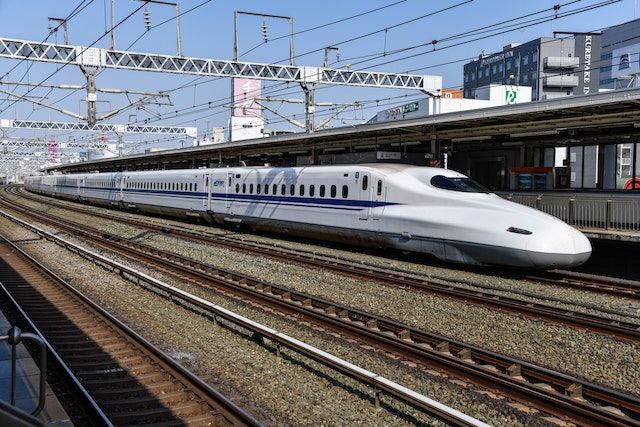
Bullet trains, also known as high-speed trains, are trains that can reach speeds of up to 186 miles per hour or more. They use advanced technology, such as aerodynamic designs, powerful engines, and specialized track systems, to allow for fast and efficient travel between cities. Bullet trains are often used as a more convenient and sustainable alternative to air travel or driving, as they can reduce travel times and greenhouse gas emissions.
In the United States, the development of high-speed rail has been a topic of debate and discussion for several decades. While there have been several attempts to develop bullet train systems in different parts of the country, progress has been slow and the technology has not been as widely adopted as it has in other countries.
One of the most notable attempts to develop high-speed rail in the United States was the California High-Speed Rail project, which was approved by voters in 2008. The project aimed to build a 520-mile rail line between San Francisco and Los Angeles, with trains that could reach speeds of up to 220 miles per hour. However, the project faced several challenges, including legal disputes, funding issues, and environmental concerns, and progress has been slow. As of 2021, only a small section of the rail line has been built, and the project’s completion is uncertain.
Another attempt to develop high-speed rail in the United States is the Northeast Corridor project, which aims to create a high-speed rail line between Boston, New York City, and Washington, D.C. The Northeast Corridor is already home to Amtrak’s Acela Express, which is the closest thing the United States has to a bullet train. The Acela Express can reach speeds of up to 150 miles per hour, but it is not as fast as some other high-speed trains around the world. The Northeast Corridor project aims to build a new line that would allow trains to travel at speeds of up to 220 miles per hour, but progress has been slow due to funding issues and political obstacles.
Other regions in the United States have also explored the possibility of developing high-speed rail systems, including Texas, Florida, and the Pacific Northwest. However, these projects have also faced challenges, including funding issues, political opposition, and technical difficulties.
One reason for the slow development of high-speed rail in the United States is the country’s large size and dispersed population. Building a high-speed rail system that connects major cities across the country would require significant investment in infrastructure and technology, as well as cooperation between different states and regions. Additionally, some critics argue that the cost of building and maintaining high-speed rail systems would be prohibitively expensive, especially when compared to other forms of transportation, such as air travel or driving.
Despite these challenges, there is still interest in developing high-speed rail in the United States, particularly as a way to reduce greenhouse gas emissions and improve transportation efficiency. In recent years, some states and regions have explored alternative models for building high-speed rail, such as public-private partnerships or incremental development. Additionally, the Biden administration has proposed a $2 trillion infrastructure plan that includes funding for high-speed rail and other sustainable transportation initiatives.
In conclusion, while the United States does have bullet trains, the technology is not as widespread or advanced as it is in some other countries. The development of high-speed rail in the United States has faced several challenges, including funding issues, political opposition, and technical difficulties. However, there is still interest in developing high-speed rail as a way to improve transportation efficiency and reduce greenhouse gas emissions, and efforts to build new systems are ongoing.