A rainbow is a beautiful and natural phenomenon that occurs in the sky when sunlight is refracted, or bent, as it passes through water droplets in the atmosphere. When the light is refracted, it is split into its component colors, creating a band of colors in the sky that we call a rainbow.
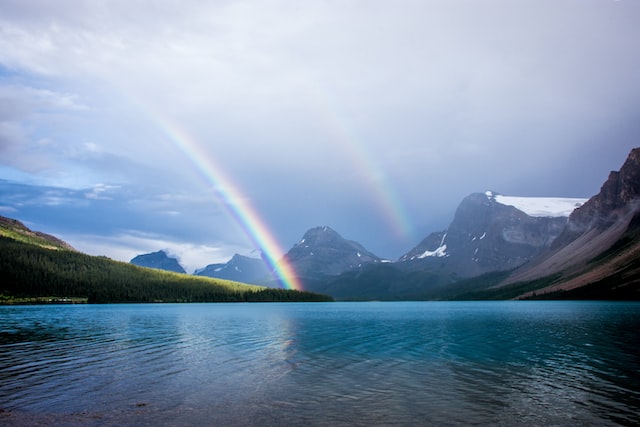
The number of colors in a rainbow is a topic that has been debated for centuries. The traditional view is that a rainbow consists of seven colors: red, orange, yellow, green, blue, indigo, and violet. This view was first proposed by Sir Isaac Newton, who, in the 17th century, discovered that white light is made up of a spectrum of colors.
Newton used a prism to demonstrate that when white light is passed through a prism, it is separated into its component colors. He identified seven colors in the spectrum and named them in the order in which they appear: red, orange, yellow, green, blue, indigo, and violet. This ordering of colors has become known as the “ROYGBIV” acronym.
The ROYGBIV acronym is widely recognized and taught in schools around the world. It is used to help people remember the order of colors in a rainbow and is often used in art and design to create color schemes.
However, some people argue that there are more than seven colors in a rainbow. This is because the colors in a rainbow are not fixed and can vary depending on the conditions in which the rainbow is formed.
For example, the size of the water droplets in the atmosphere can affect the colors that are visible in a rainbow. If the droplets are very small, the colors in the rainbow will be very distinct and bright. However, if the droplets are larger, the colors will be less distinct and may appear blended together.
Similarly, the angle of the sunlight can also affect the colors in a rainbow. If the sun is low in the sky, the rainbow will appear higher in the sky and the colors will be more spread out. If the sun is high in the sky, the rainbow will appear lower in the sky and the colors will be more compact.
Under certain conditions, it is possible to see additional colors in a rainbow. For example, some people claim to see a pink or purple color in a rainbow, which is not part of the traditional seven-color spectrum. This is thought to be caused by the mixing of colors at the edges of the spectrum.
In addition to the visible colors in a rainbow, there are also colors that are not visible to the human eye. These are known as ultraviolet and infrared light. Ultraviolet light has a shorter wavelength than visible light and is found beyond the violet end of the spectrum. Infrared light has a longer wavelength than visible light and is found beyond the red end of the spectrum.
Although these colors are not visible in a rainbow, they play an important role in the formation of the rainbow. Ultraviolet light is responsible for the fluorescence of some minerals and is also used in UV lamps for disinfection purposes. Infrared light is used in heating and cooking appliances, as well as in remote controls and other electronic devices.
In conclusion, the number of colors in a rainbow is a topic that has been debated for centuries. The traditional view is that there are seven colors in a rainbow: red, orange, yellow, green, blue, indigo, and violet. However, under certain conditions, additional colors may be visible, and there are also colors that are not visible to the human eye. Regardless of the number of colors in a rainbow, it is a beautiful and natural phenomenon that has captivated people for generations.