Ants are tiny, six-legged insects that belong to the family Formicidae. They are found on every continent except Antarctica and are considered one of the most successful and dominant groups of insects on the planet. Ants come in a wide variety of sizes, colors, and shapes, and they play a critical role in many ecosystems, including soil aeration, seed dispersal, and pest control.
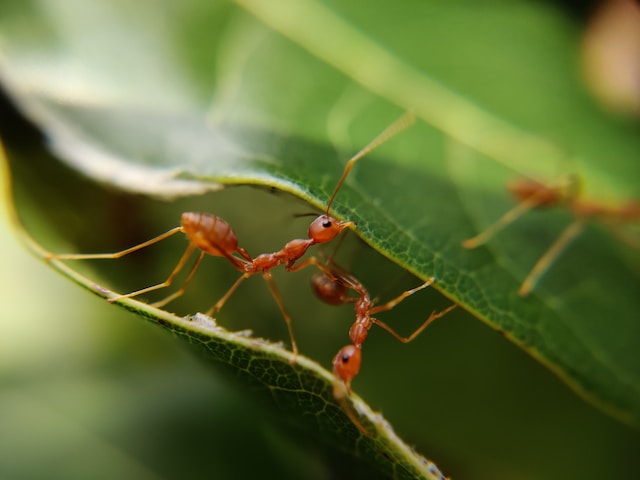
The number of legs that an ant has is a simple answer – ants have six legs. As with all insects, ants have three body segments: the head, thorax, and abdomen. The legs of an ant are attached to the thorax, which is the middle segment of its body. Each leg has several segments, including a coxa, a trochanter, a femur, a tibia, and a tarsus. These segments allow ants to move quickly and efficiently over a wide range of surfaces.
Ants use their legs for many purposes, including walking, running, climbing, and digging. They can also use their legs to communicate with one another, using pheromones and touch to send signals and convey information. Ants can detect chemical signals with their antennae, which are also attached to their head. The size and shape of an ant’s legs can vary depending on its species and role within the colony.
For example, worker ants have longer legs than the queen or male ants, which allows them to move more quickly and efficiently. Some ant species have spines or other adaptations on their legs that help them climb and cling to surfaces. These adaptations help ants to survive and thrive in their environments.
In addition to their legs, ants have other adaptations that help them survive and thrive in their environments. They have powerful jaws that they use to capture and manipulate food. Ants also have venomous stingers that they use to defend themselves and their colonies. These adaptations are crucial to their survival, allowing them to protect themselves and their homes from potential predators.
Ants also have complex social structures and communication systems that allow them to work together effectively and respond to changes in their environment. Ants live in colonies with specific roles assigned to different members. For example, there are worker ants who gather food, tend to the young, and maintain the nest. There are also male and female ants that are responsible for reproducing and expanding the colony. The queen ant, in particular, is responsible for laying eggs and ensuring the survival of the colony.
In conclusion, ants are remarkable creatures with a wide range of adaptations and behaviors. They may seem small and insignificant, but they play a crucial role in many ecosystems and have a significant impact on the world around us. Ants have evolved over millions of years to become one of the most successful groups of insects on the planet. Their legs are just one of many adaptations that have helped them to survive and thrive in their environments. Through their complex social structures and communication systems, ants have built societies that are incredibly efficient and effective. As such, ants are a testament to the ingenuity and adaptability of the natural world, and they serve as a reminder of the remarkable diversity of life on our planet.