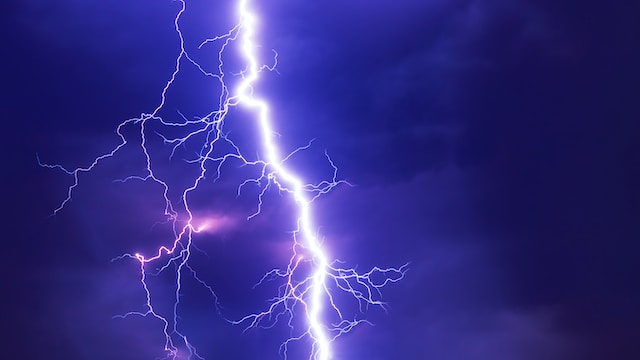
Lightning is a powerful natural phenomenon that occurs when the electric charge in the atmosphere is discharged between two regions of opposite charge. Lightning is a rapid and intense burst of electrical energy that produces a visible flash of light and a loud thunderclap. The voltage of lightning can vary widely, depending on the specific conditions of the storm, but it typically ranges from several hundred million to over a billion volts.
To understand the voltage of lightning, it is helpful to first understand the basic physics of electricity. Electricity is the flow of charged particles, such as electrons or ions, through a conductor. The unit of electric potential is the volt, which is defined as the potential energy difference between two points in a circuit that allows one joule of energy to be transferred per coulomb of charge. In other words, voltage is a measure of the potential energy that is available to move charged particles through a circuit.
In the atmosphere, lightning is produced by the build-up of electric charge in clouds. Thunderstorms are characterized by the separation of charge between the bottom of the cloud and the ground. This separation of charge creates a potential difference, or voltage, between the two regions. When the voltage becomes high enough, the electric charge is discharged in the form of a lightning bolt.
The voltage of lightning can vary widely depending on the specific conditions of the storm. The voltage is primarily determined by the distance between the regions of opposite charge and the magnitude of the charge separation. The typical voltage of a lightning bolt is estimated to be between 100 million and 1 billion volts, although some bolts can reach voltages as high as 1.2 billion volts.
The voltage of lightning is not a constant value, but rather varies over the course of the lightning bolt. The lightning bolt is comprised of a series of electrical discharges, each of which may have a different voltage. The initial discharge, known as the stepped leader, can have a voltage of several hundred thousand volts. This initial discharge creates a channel of ionized air that allows subsequent discharges to occur.
The subsequent discharges, known as return strokes, can have voltages of several hundred million volts. The return strokes are the most intense and visible part of the lightning bolt, producing the bright flash of light and the loud thunderclap. The return stroke occurs when the charge separation between the cloud and the ground is neutralized, causing a rapid discharge of electrical energy.
In addition to the voltage, the current of lightning is also an important factor in its power and destructive capability. The current of lightning can range from 10,000 to 200,000 amperes, with an average of 30,000 amperes. The combination of high voltage and high current makes lightning a dangerous and destructive force.
In conclusion, the voltage of lightning can vary widely depending on the specific conditions of the storm, but it typically ranges from several hundred million to over a billion volts. The voltage of lightning is determined by the distance between the regions of opposite charge and the magnitude of the charge separation. The voltage of lightning is not a constant value, but rather varies over the course of the lightning bolt. The current of lightning is also an important factor in its power and destructive capability. Lightning is a dangerous and destructive force that requires caution and respect.