A light year is a unit of measurement used in astronomy to describe distances across the vastness of space. It is defined as the distance that light travels in one year, and is equivalent to approximately 9.46 trillion kilometers or 5.88 trillion miles.
To better understand what a light year is and how it’s used in astronomy, it’s important to first have a basic understanding of what light is and how it travels. Light is a form of electromagnetic radiation, which means it consists of waves that oscillate at a particular frequency. These waves can travel through a vacuum, such as the empty space between the stars and galaxies of the universe.
The speed of light is a fundamental constant of the universe, and it’s defined as approximately 299,792,458 meters per second (or about 670,616,629 miles per hour). This means that light can travel a distance of one light year in one year, because the speed of light is constant and unchanging.
To put the distance of one light year into perspective, imagine traveling from Earth to the nearest star to our solar system, which is Proxima Centauri. Proxima Centauri is located approximately 4.24 light years away, which means that light emitted from Proxima Centauri takes over four years to reach Earth. In other words, we are seeing Proxima Centauri as it appeared over four years ago, because that’s how long it took for the light to travel to us.
One of the most significant implications of the concept of a light year is that it allows astronomers to measure vast distances in space without having to rely on other, less precise methods. Because the speed of light is a constant, unchanging value, it provides a consistent standard against which to measure distances. This is in contrast to other methods of distance measurement, such as parallax or redshift, which rely on assumptions and may not be as accurate.
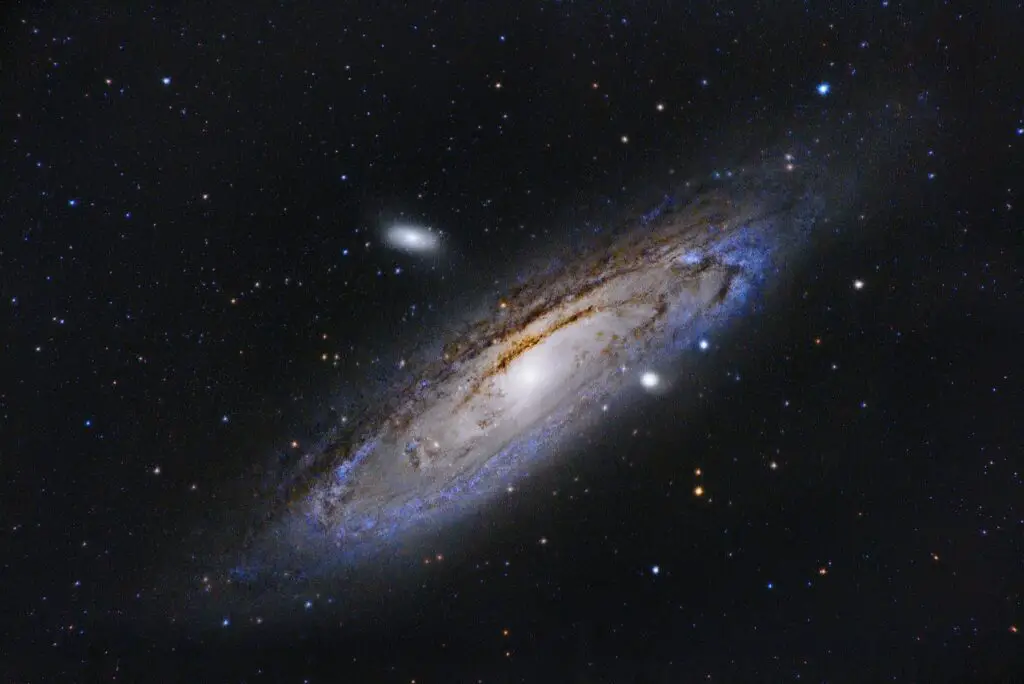
In addition to providing a way to measure distances, the concept of a light year also has important implications for our understanding of the universe. For example, when we observe distant galaxies, we are actually seeing them as they appeared billions of years ago, because that’s how long it took for the light to travel from those galaxies to us. By studying these distant galaxies, we can learn about the history and evolution of the universe, and gain insights into some of its most fundamental questions.
It’s worth noting that while a light year is a useful unit of measurement for astronomical distances, it’s not without its limitations. For one, it can be difficult to conceptualize such vast distances, because they are so far beyond our normal human experience. Additionally, the speed of light is not an absolute limit on the speed at which things can travel, as some science fiction enthusiasts might be quick to point out. However, as far as we know based on our current understanding of physics, the speed of light remains the ultimate speed limit of the universe.
In summary, a light year is the distance that light travels in one year, and is equivalent to approximately 9.46 trillion kilometers or 5.88 trillion miles. It provides a consistent and precise way to measure distances in space, and allows astronomers to study the history and evolution of the universe by observing distant galaxies and other celestial objects. While it has its limitations, the concept of a light year remains a fundamental tool in the field of astronomy, and is likely to continue to be so for many years to come.