Carnivorous plants are fascinating organisms that have adapted to capture and digest prey, primarily insects, to supplement their nutrient intake. These unique plants thrive in nutrient-poor environments where traditional sources of nutrients are scarce.
This article explores various types of carnivorous plants, their mechanisms for trapping prey, and their ecological significance.
Introduction to Carnivorous Plants
Carnivorous plants are remarkable organisms that have evolved to capture and digest prey, mainly insects, to enhance their nutrient intake.
These plants thrive in environments where soil nutrients are limited, making their unique adaptations essential for survival.
Types and Mechanisms of Carnivorous Plants
Among the most well-known carnivorous plants are the Venus flytrap, pitcher plants, and sundews, each employing distinct trapping mechanisms.
The Venus flytrap utilizes snap traps, which quickly close when prey touches its sensitive hairs, effectively capturing unsuspecting insects.
In contrast, pitcher plants feature pitfall traps, where their tubular structure filled with liquid lures and traps prey that slips into the depths.
The Venus Flytrap: Nature’s Snap Trap
The Venus flytrap is perhaps the most iconic of carnivorous plants, known for its jaw-like leaves that snap shut.
This plant thrives in nutrient-poor soils, relying on its ability to catch insects to supplement its diet.
Its rapid movement is not only fascinating but also a critical adaptation that allows it to capture fast-moving prey.
Pitcher Plants: The Tubular Trap
Pitcher plants present a different approach to capturing prey, with their unique tubular structures filled with digestive liquid.
These plants attract insects with their vibrant colors and sweet nectar, leading them to the slippery rim of the pitcher.
Once inside, the insects find it difficult to escape, ultimately falling into the liquid where they are digested.
Sundews: Sticky Tentacles of Capture
Sundews are characterized by their sticky glandular hairs that glisten with dew droplets, enticing insects to land on them.
When an insect makes contact, the tentacles curl around the prey, securing it for digestion.
This method is particularly effective in capturing small insects, showcasing the diverse strategies employed by carnivorous plants.
The Ecological Significance of Carnivorous Plants
Carnivorous plants play a vital role in their ecosystems, helping to control insect populations and contributing to nutrient cycling.
By trapping and digesting insects, these plants not only supplement their nutrient intake but also provide a unique habitat for various organisms.
Understanding their adaptations and ecological roles highlights the importance of preserving these fascinating plants and their habitats.
Types and Mechanisms of Carnivorous Plants
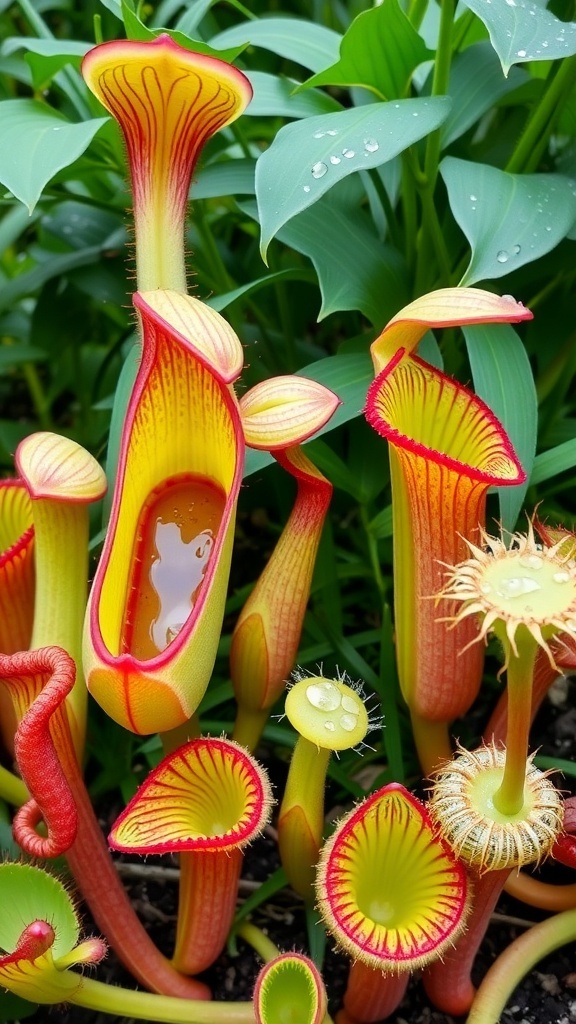
Carnivorous plants, such as Venus flytraps, pitcher plants, and sundews, utilize different trapping mechanisms. Venus flytraps employ snap traps, pitcher plants use pitfall traps, and sundews feature sticky glandular hairs to ensnare their prey. Understanding these mechanisms provides insight into their survival strategies in challenging habitats.
Ingredients
Instructions
Cook and Prep Times
- Prep Time: N/A
- Cook Time: N/A
- Total Time: N/A
- Servings: N/A
- Calories: N/A
- Fat: N/A
- Protein: N/A
- Carbohydrates: N/A