Polarity is a property of a molecule that refers to the distribution of its electron charge. Polar molecules have an uneven distribution of electrons, resulting in a dipole moment, while nonpolar molecules have an even distribution of electrons, resulting in no dipole moment. In this article, we will discuss some examples of polar and nonpolar molecules.
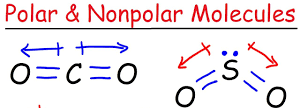
Examples of polar molecules:
- Water (H2O) – Water is a polar molecule due to its bent molecular geometry and the electronegativity difference between the oxygen and hydrogen atoms. The oxygen atom is more electronegative than the hydrogen atoms, so the electrons are more attracted to the oxygen atom, resulting in a partial negative charge on the oxygen atom and a partial positive charge on the hydrogen atoms.
- Ammonia (NH3) – Ammonia is a polar molecule due to its trigonal pyramidal molecular geometry and the electronegativity difference between the nitrogen and hydrogen atoms. The nitrogen atom is more electronegative than the hydrogen atoms, so the electrons are more attracted to the nitrogen atom, resulting in a partial negative charge on the nitrogen atom and a partial positive charge on the hydrogen atoms.
- Carbon dioxide (CO2) – Carbon dioxide is a polar molecule due to its linear molecular geometry and the dipole moment of its bonds. While the individual bonds between the carbon and oxygen atoms are polar, the molecule as a whole is nonpolar because the dipole moments cancel each other out.
- Ethanol (C2H5OH) – Ethanol is a polar molecule due to the presence of the hydroxyl (-OH) functional group. The oxygen atom in the hydroxyl group is more electronegative than the carbon and hydrogen atoms, resulting in a partial negative charge on the oxygen atom and a partial positive charge on the carbon and hydrogen atoms.
- Acetic acid (CH3COOH) – Acetic acid is a polar molecule due to the presence of the carboxyl (-COOH) functional group. The oxygen atom in the carboxyl group is more electronegative than the carbon and hydrogen atoms, resulting in a partial negative charge on the oxygen atom and a partial positive charge on the carbon and hydrogen atoms.
Examples of nonpolar molecules:
- Carbon tetrachloride (CCl4) – Carbon tetrachloride is a nonpolar molecule due to its tetrahedral molecular geometry and the electronegativity equality between the carbon and chlorine atoms. The electronegativities of carbon and chlorine are similar, resulting in an even distribution of electrons and no dipole moment.
- Methane (CH4) – Methane is a nonpolar molecule due to its tetrahedral molecular geometry and the electronegativity equality between the carbon and hydrogen atoms. The electronegativities of carbon and hydrogen are similar, resulting in an even distribution of electrons and no dipole moment.
- Nitrogen gas (N2) – Nitrogen gas is a nonpolar molecule due to the electronegativity equality between the nitrogen atoms. The electronegativities of nitrogen are similar, resulting in an even distribution of electrons and no dipole moment.
- Ozone (O3) – Ozone is a nonpolar molecule despite its bent molecular geometry. The oxygen-oxygen bond is polar, but the dipole moments of the bonds cancel each other out, resulting in an even distribution of electrons and no dipole moment.
- Tetrachloroethylene (C2Cl4) – Tetrachloroethylene is a nonpolar molecule due to its tetrahedral molecular geometry and the electronegativity equality between the carbon and chlorine atoms. The
What are examples of polar and nonpolar molecules?