The $2 bill in the United States showcases the portrait of Thomas Jefferson, who was the third president of the country. Jefferson is widely acknowledged as one of the most significant personalities in American history, and his contributions to the nation are still noticeable to this day.
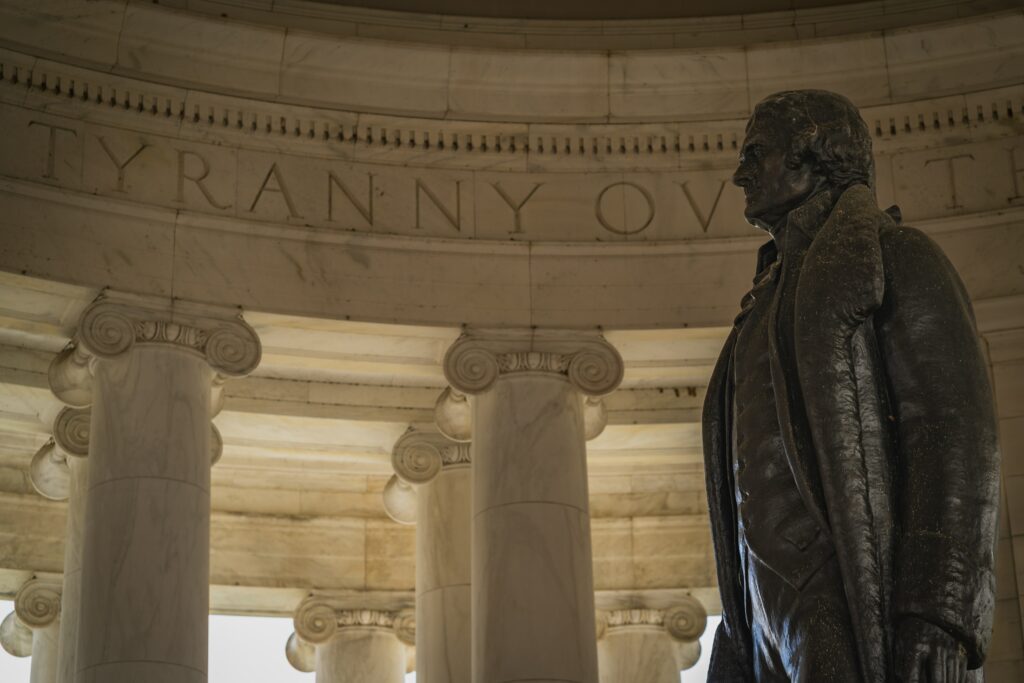
Jefferson was born in Virginia in 1743 and received a classical education from the College of William and Mary. He became a lawyer and joined the Virginia House of Burgesses in 1769, where he quickly established himself as a skilled orator and an advocate for colonial rights.
During the American Revolution, Jefferson served in the Virginia legislature and was a delegate to the Continental Congress. He is best known for drafting the Declaration of Independence in 1776, which established the principles of freedom, equality, and democracy as the foundation of American government.
After the war, Jefferson entered Virginia politics and served as the state’s governor from 1779 to 1781. He then returned to the Continental Congress, where he played a crucial role in drafting the Articles of Confederation, the first constitution of the United States.
In 1784, Jefferson went to Paris as a diplomat and served as the United States minister to France. During his stay in Europe, he became friends with many of the leading intellectuals and philosophers of the time, including Benjamin Franklin and the Marquis de Lafayette.
In 1790, Jefferson became the first Secretary of State under President George Washington. He held this position for four years, during which he had disagreements with Alexander Hamilton, the Secretary of the Treasury, over the direction of American foreign policy.
In 1796, Jefferson ran for president against John Adams and lost, but he was elected as Vice President, which he held until 1801.
In 1800, Jefferson ran for president again and won against Charles Pinckney, Adams’s running mate. He was inaugurated as the third president of the United States on March 4, 1801.
As president, Jefferson facilitated the expansion of the United States to the west, including the Louisiana Purchase in 1803, which doubled the country’s size. He also championed the values of limited government, states’ rights, and individual liberty, which became the core values of the Democratic-Republican Party, which he founded.
Jefferson’s presidency faced criticism due to his handling of foreign affairs, including his embargo of trade with Europe, which adversely affected American businesses and farmers. He also faced opposition from Federalists who saw him as a threat to their vision of America and believed in a stronger federal government.
In conclusion, Thomas Jefferson, the third president of the United States, is the person featured on the $2 bill. His legacy as a founding father, author of the Declaration of Independence, and advocate of individual liberty and limited government continues to influence the country to this day, making him one of the most important figures in American history.