Voyager 1 is a space probe that was launched by NASA in 1977 to study the outer Solar System and beyond. After over four decades of operation, Voyager 1 has become the farthest human-made object from Earth, and it continues to travel further away from us. As of 2023, Voyager 1 is located over 14.2 billion miles (22.9 billion kilometers) from Earth, traveling at a speed of about 38,000 miles per hour (61,000 kilometers per hour). Here is a more detailed description of Voyager 1’s current location and trajectory.
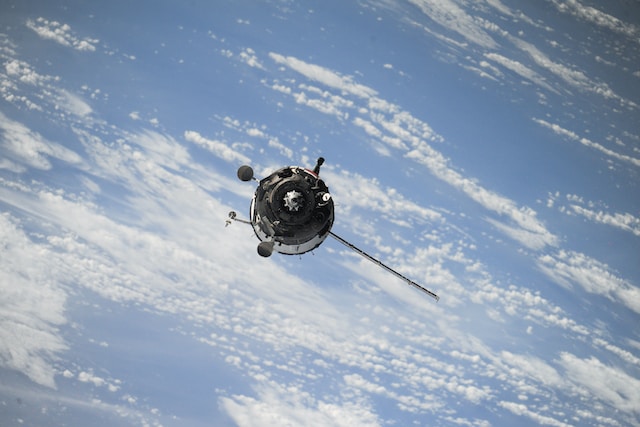
Voyager 1’s mission was to explore the outer planets of our Solar System, namely Jupiter, Saturn, Uranus, and Neptune. It accomplished this mission successfully and made many important discoveries along the way, such as the existence of active volcanoes on Jupiter’s moon Io, the intricate rings of Saturn, and the presence of geysers on Neptune’s moon Triton. However, Voyager 1’s greatest achievement may have been its ability to capture images and data from these planets and their moons, providing scientists with valuable insights into the composition and structure of our Solar System.
After completing its primary mission, Voyager 1 continued to travel outward, entering a region of space called the heliosheath, which marks the boundary between the Sun’s influence and interstellar space. The heliosheath is a turbulent region where the solar wind collides with the interstellar medium, creating a bow shock that deflects most of the charged particles from the Sun. Voyager 1 crossed this boundary in August 2012, becoming the first human-made object to enter interstellar space.
Since then, Voyager 1 has been exploring the interstellar medium, sending back data on the density, temperature, and magnetic field of this mysterious region. It has also detected the presence of cosmic rays, energetic particles that come from distant supernovae and other cosmic events. By studying these particles, scientists hope to learn more about the origins of our Universe and the processes that drive cosmic evolution.
Voyager 1’s current location is difficult to pinpoint precisely, as it is traveling through space at a high velocity and is subject to the gravitational forces of other objects in the Milky Way Galaxy. However, its position is tracked by NASA’s Deep Space Network, a network of antennas that communicate with the probe and receive its data transmissions. Based on these measurements, scientists estimate that Voyager 1 is currently located in the outer regions of the heliosphere, a vast bubble of charged particles created by the solar wind.
As of 2023, Voyager 1 is traveling in the general direction of the constellation Ophiuchus, which lies in the southern hemisphere of the sky. Its exact path will depend on the gravitational forces it encounters as it travels through the interstellar medium. However, scientists believe that Voyager 1 will continue to travel in a roughly straight line, eventually passing through the Oort Cloud, a vast shell of icy objects that surrounds our Solar System. If Voyager 1 is still operational by that time, it may be able to provide valuable data on the composition and structure of this distant region of space.
In conclusion, Voyager 1 is currently traveling through the interstellar medium, sending back valuable data on this mysterious region of space. Its exact location is difficult to determine, but it is estimated to be over 14.2 billion miles from Earth and traveling at a speed of 38,000 miles per hour. Voyager 1 has already achieved many important milestones in its long journey through the Solar System, and it may continue to provide valuable insights into the workings of our Universe for decades to come.