In the Bible, the term “angel of death” is not explicitly used. However, there are references to angels who have been involved in bringing about death and destruction as part of God’s judgment or plan.
One such reference can be found in the Book of Exodus, which describes the tenth plague that God sent upon Egypt. This plague, also known as the “plague of the firstborn,” involved the death of every firstborn son in the land of Egypt, from the Pharaoh’s palace to the poorest of households. According to the Bible, God instructed Moses to tell the Israelites to mark their doors with the blood of a lamb so that the “angel of death” would “pass over” their homes and spare their firstborn sons.
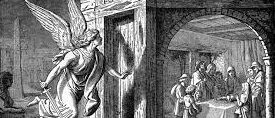
While the term “angel of death” is not used in this context, it is generally understood to refer to the angel who carried out God’s judgment upon Egypt by taking the lives of the firstborn sons. This angel is not named in the Bible, but is commonly referred to as the “destroyer” based on the description in Exodus 12:23, which states: “When the Lord goes through the land to strike down the Egyptians, he will see the blood on the top and sides of the doorframe and will pass over that doorway, and he will not permit the destroyer to enter your houses and strike you down.”
In addition to the “angel of death” who carried out the tenth plague, there are other angels in the Bible who are associated with death and destruction. One such angel is Abaddon or Apollyon, who is mentioned in the Book of Revelation as the king of the “bottomless pit” and the ruler of a swarm of locusts that are unleashed upon the earth to torment humanity. According to Revelation 9:11, Abaddon is “the angel of the abyss,” which is another way of describing the realm of the dead.
Another angel associated with death is Azrael, who is mentioned in Islamic and Jewish traditions rather than in the Bible itself. According to these traditions, Azrael is the angel of death who is responsible for separating the souls from the bodies of the deceased. While Azrael is not mentioned in the Bible, the concept of an angel who presides over death and the afterlife is a common one in many religious traditions.
It is worth noting that the idea of an “angel of death” who is responsible for taking the lives of individuals is not a central tenet of Christian theology. Instead, Christians believe that death is a natural part of the human experience and that it is ultimately under God’s control. While angels may be involved in carrying out God’s will in certain instances, they are not seen as independent agents who have the power to cause death or destruction on their own.
In conclusion, the Bible does not explicitly mention an “angel of death,” but there are angels who are associated with death and destruction as part of God’s judgment or plan. The most well-known example is the “destroyer” who carried out the tenth plague in Egypt, but there are also other angels mentioned in the Bible and in other religious traditions who are associated with death and the afterlife. Ultimately, however, Christians believe that death is under God’s control and that it is part of His plan for humanity.