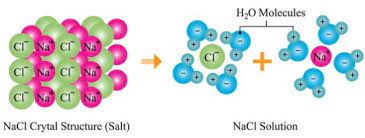
Sodium chloride (NaCl) is a strong electrolyte because it dissociates completely into its constituent ions when dissolved in water. This means that when NaCl is added to water, the NaCl molecules break apart into Na+ and Cl- ions, which are surrounded by water molecules. These ions are free to move and conduct electricity, making NaCl a strong electrolyte.
To understand why NaCl is a strong electrolyte, it’s important to understand the concept of electrolytes and their behavior in water. An electrolyte is a substance that conducts electricity when dissolved in water. Electrolytes are made up of ions, which are atoms or molecules that have an unequal number of electrons and protons. This means that ions have a net electrical charge, either positive or negative.
When an electrolyte is added to water, the water molecules surround the ions, which become solvated. The solvation of ions in water is an important factor in determining the strength of an electrolyte. A strong electrolyte, like NaCl, completely dissociates into its constituent ions when dissolved in water. This means that all of the NaCl molecules in the solution break apart into Na+ and Cl- ions, and these ions are surrounded by water molecules.
The dissociation of NaCl in water can be represented by the following equation:
NaCl (s) → Na+ (aq) + Cl- (aq)
This equation shows that when solid NaCl is added to water, it dissociates into Na+ and Cl- ions, which are now in the aqueous (or dissolved) state. These ions are surrounded by water molecules, which are attracted to the ions because of their opposite charges. This attraction between ions and water molecules is known as solvation, and it stabilizes the ions in solution.
Because NaCl completely dissociates into its constituent ions when dissolved in water, it is a strong electrolyte. This means that it conducts electricity very well when in solution. When a voltage is applied to a solution of NaCl, the Na+ and Cl- ions are free to move and carry electrical current. This is because the ions are surrounded by water molecules, which act as a medium for the ions to move through. The movement of ions in solution is what allows NaCl to conduct electricity so effectively.
Another factor that contributes to the strength of NaCl as an electrolyte is its high solubility in water. NaCl is highly soluble in water, meaning that a large amount of NaCl can dissolve in a given amount of water. This means that there are a large number of ions present in solution, which increases the conductivity of the solution.
In addition to being a strong electrolyte, NaCl has a number of important applications in chemistry and industry. It is commonly used as a food preservative and flavor enhancer, and is also used in the production of chlorine and other chemicals. NaCl is also an important component of saline solution, which is used in medicine for a variety of purposes, including rehydration and intravenous therapy.
In conclusion, NaCl is a strong electrolyte because it dissociates completely into its constituent ions when dissolved in water. This means that NaCl molecules break apart into Na+ and Cl- ions, which are surrounded by water molecules and are free to move and conduct electricity. The dissociation of NaCl into its constituent ions is due to the high solvation of these ions in water, which stabilizes them in solution. NaCl’s high solubility in water also contributes to its strength as an electrolyte, as it allows for a large number of ions to be present in solution. These factors make NaCl a very effective conductor of electricity and an important substance in a variety of applications.