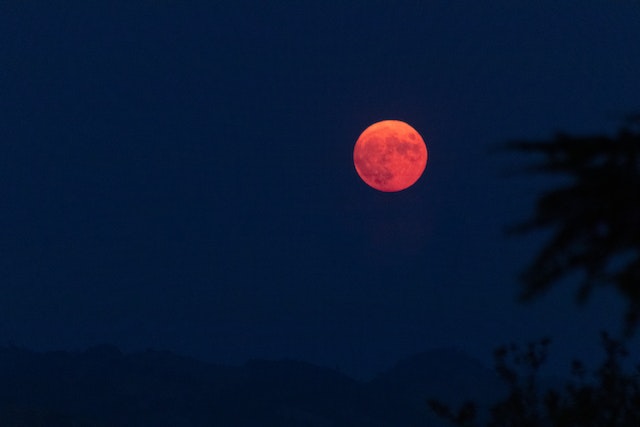
The moon is one of the most fascinating celestial objects in the night sky, and it never ceases to amaze us with its changing appearance. The moon can take on various colors, from bright white to yellow, orange, and even red. The reason why the moon appears orange tonight can be explained by a few different factors, including atmospheric conditions and the moon’s position in the sky.
To understand why the moon appears orange, we need to understand the basics of light and color. When light travels through the atmosphere, it gets scattered in all directions by air molecules and other particles. This scattering of light is what causes the sky to appear blue during the day. However, during sunset or sunrise, the sunlight travels through more of the Earth’s atmosphere before reaching our eyes, and this scattering process changes the color of the light that we see.
When the sun is low on the horizon during sunrise or sunset, its light has to travel through a greater amount of Earth’s atmosphere than during other times of the day. During this time, blue light is scattered away from the direct path of the sun’s rays, making the sky appear red, orange, or yellow. This is why the sky is often very colorful during these times.
Now, if we turn our attention to the moon, we can understand why it may appear orange during certain times. The moon reflects sunlight just like any other object. During a full moon, the moon is on the opposite side of the Earth from the sun, which means that the sunlight is hitting the moon directly. However, when the moon is rising or setting, the light has to travel through more of Earth’s atmosphere before reaching our eyes. Just like during sunrise or sunset, this scattering process can cause the light to appear orange or red.
The color of the moon during a rising or setting can also depend on the amount of dust, smoke, or pollution in the atmosphere. These particles can scatter the light in different ways, causing the moon to appear more orange or red than usual. For example, after a volcanic eruption, the moon may appear more red because of the ash particles in the atmosphere.
Another factor that can affect the color of the moon is its position in the sky. When the moon is low on the horizon, it appears larger than when it is high in the sky. This is called the moon illusion, and it’s still not entirely understood by scientists. However, some researchers believe that it has to do with the way our brain processes visual information. When the moon is low on the horizon, we have objects to compare its size to, such as buildings or trees, which can make it appear larger.
The color of the moon can also be affected by the time of year. In some parts of the world, the moon may appear more orange or red during the winter months when the air is colder and dryer. This is because cold air is denser than warm air, which causes the light to scatter differently.
In conclusion, the moon can appear orange or red during certain times because of the way that light is scattered by Earth’s atmosphere. When the moon is low on the horizon, the light has to travel through more of the atmosphere, which can cause the light to appear more orange or red. The color of the moon can also be affected by the amount of dust, smoke, or pollution in the atmosphere, as well as its position in the sky and the time of year. While the moon’s color may be a fascinating phenomenon, it is also a reminder of the complex interplay between the Earth, the moon, and the sun, and the way that light travels through space.