The moon can appear orange or red during certain atmospheric conditions, such as during a lunar eclipse or a certain phase of the moon’s cycle.
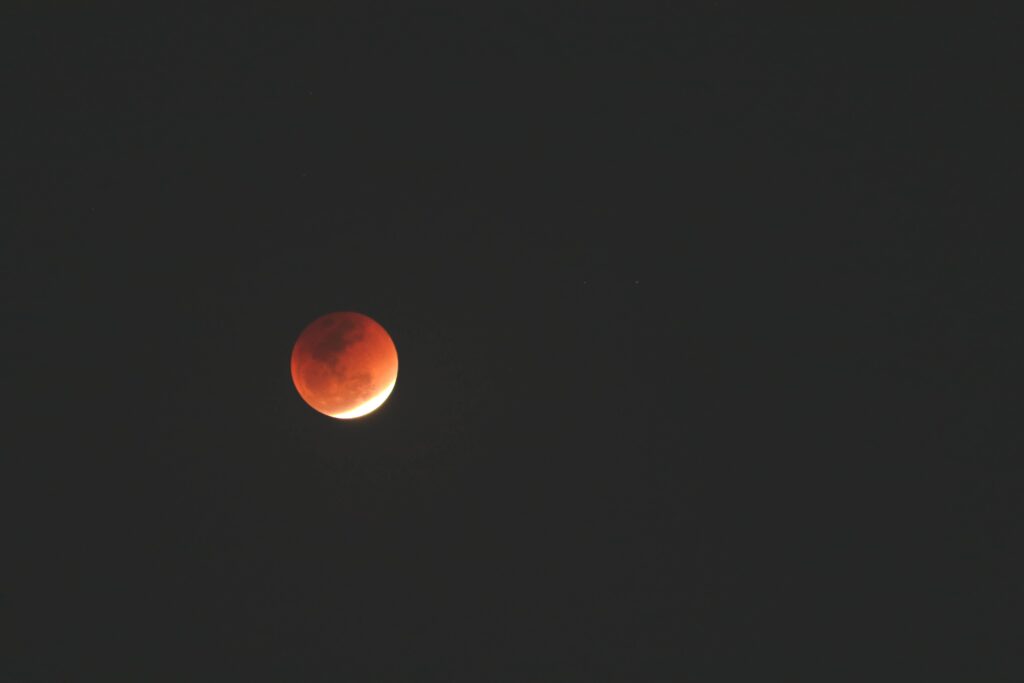
During a lunar eclipse, the Earth moves between the sun and the moon, casting a shadow on the moon’s surface. This shadow is visible to observers on Earth as the moon takes on a reddish or orange hue. This happens because the Earth’s atmosphere scatters and filters the sun’s light as it passes through the atmosphere, and the remaining light is cast on the moon, giving it a reddish-orange color.
At other times, the moon may appear orange or red due to the scattering of light in the Earth’s atmosphere. This happens because light from the sun passes through the Earth’s atmosphere, which filters out shorter wavelengths of light such as blue and green. The remaining light that reaches the moon is mostly in the orange and red part of the spectrum, giving it an orange or reddish hue.
The color of the moon can also appear to change during certain phases of the moon’s cycle, such as during a full moon or a supermoon. This is due to the angle at which the moon’s light is hitting the Earth’s atmosphere, which can cause the moon to appear larger or smaller and change the way its light is scattered.
In conclusion, the moon can appear orange due to the scattering of light in the Earth’s atmosphere, which can filter out shorter wavelengths of light and leave behind mostly orange and red light. It can also appear orange or red during a lunar eclipse, when the Earth casts a shadow on the moon’s surface and the remaining light is scattered and filtered by the Earth’s atmosphere.