Baking with yeast requires specific tools to ensure successful fermentation and dough development. These essential yeast tools help bakers achieve the perfect rise and texture in their baked goods.
From measuring ingredients accurately to creating the ideal environment for yeast activation, having the right tools can make a significant difference in your baking results.
Essential Baking Tools for Yeast
Baking with yeast requires a set of specific tools that can significantly enhance the process.
These tools not only help in measuring ingredients accurately but also create the right environment for yeast to thrive.
Having the right equipment is essential for achieving that perfect rise and texture in your baked goods.
Digital Kitchen Scale
A digital kitchen scale is a must-have for any baker working with yeast.
It allows for precise measurements, which is crucial when it comes to ingredients like flour.
Even a slight variation in the amount of flour can affect the dough’s consistency and the final product.
Using a scale ensures that you are using the exact amount needed for successful fermentation and dough development.
This accuracy is particularly important when scaling recipes or trying new ones.
Measuring Cups and Mixing Bowls
Measuring cups and spoons are essential for both dry and liquid ingredients.
They help ensure that you have the right ratios for your yeast-based recipes.
Mixing bowls in various sizes are equally important for combining ingredients effectively.
Having a set of mixing bowls allows you to prepare different components of your recipe simultaneously, streamlining the baking process.
Choose bowls that are easy to handle and clean, as they will be used frequently.
Proofing Basket
A proofing basket, or banneton, is a specialized tool that helps shape and support the dough during its rise.
These baskets create a warm environment that is ideal for yeast activation.
They also help maintain the dough’s shape, resulting in a better final product.
Using a proofing basket can enhance the texture of your bread, giving it a beautiful crust and structure.
It’s a simple yet effective tool that every yeast baker should consider adding to their collection.
Bench Scraper
The bench scraper is a versatile tool that is invaluable when working with dough.
It can be used for cutting, portioning, and transferring dough, making it easier to handle.
This tool is especially helpful when kneading and shaping your dough on a floured surface.
With a bench scraper, you can easily lift and fold the dough without it sticking to your hands or the countertop.
This efficiency can make the baking process smoother and more enjoyable.
Additional Tools for Success
In addition to the primary tools mentioned, there are a few more that can enhance your baking experience.
A rolling pin is useful for flattening dough, while a baking stone or sheet ensures even heat distribution during baking.
An instant-read thermometer can help check the dough temperature, ensuring it’s at the right level for yeast activity.
Covering the dough with plastic wrap or a kitchen towel during proofing is also essential to maintain moisture.
These additional tools can make a significant difference in the quality of your baked goods.
Key Tools for Working with Yeast
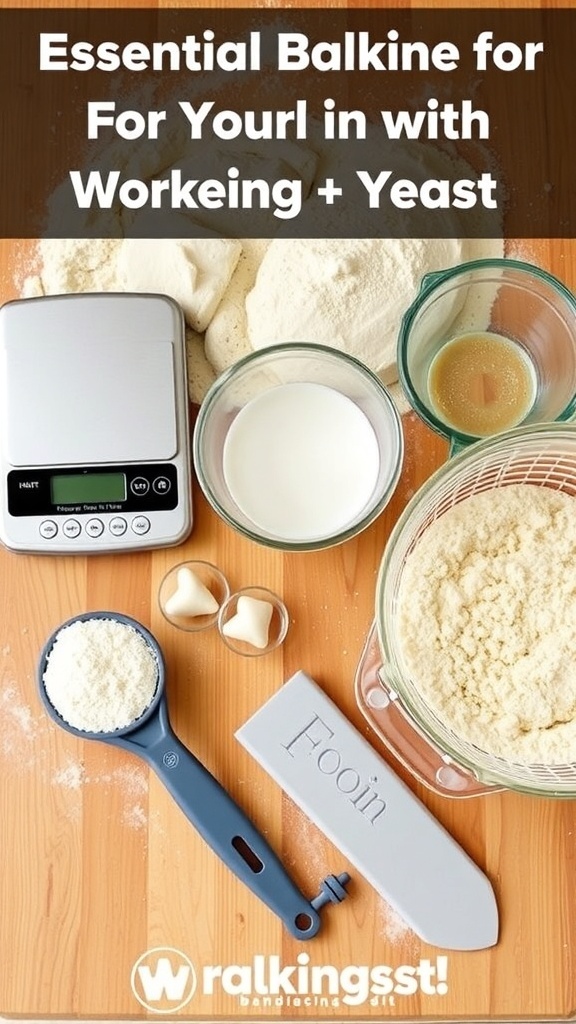
This guide covers the essential tools needed for working with yeast, including measuring cups, mixing bowls, proofing baskets, and more. Each tool plays a vital role in the baking process, ensuring that your dough rises properly and bakes evenly.
Ingredients
- Digital kitchen scale for precise measurements
- Measuring cups and spoons for dry and liquid ingredients
- Mixing bowls in various sizes for combining ingredients
- Whisk or dough whisk for mixing yeast and liquids
- Proofing basket or bowl for shaping and rising dough
- Bench scraper for cutting and handling dough
- Rolling pin for flattening dough
- Baking stone or sheet for even heat distribution
- Instant-read thermometer to check dough temperature
- Plastic wrap or kitchen towel for covering dough during proofing
Instructions
- Measure Ingredients: Use a digital kitchen scale for accuracy when measuring flour and other dry ingredients.
- Mix Ingredients: Combine yeast with warm water and sugar in a mixing bowl using a whisk to activate the yeast.
- Knead Dough: Use a bench scraper to handle and knead the dough on a floured surface until smooth and elastic.
- Proof Dough: Place the dough in a proofing basket or bowl, cover with plastic wrap or a kitchen towel, and let it rise in a warm environment.
- Shape and Bake: After proofing, shape the dough as desired, place it on a baking stone or sheet, and bake according to your recipe.
Cook and Prep Times
- Prep Time: Varies by recipe
- Cook Time: Varies by recipe
- Total Time: Varies by recipe
- Servings: N/A
- Calories: N/A
- Fat: N/A
- Protein: N/A
- Carbohydrates: N/A