The triangle choke is a submission hold commonly used in martial arts, particularly Brazilian Jiu-Jitsu. It is a technique that can be used to force an opponent to submit by cutting off their blood supply to the brain. The choke involves using one’s legs to create a triangular shape around the opponent’s neck, with one arm inside the triangle and the other arm outside. In this article, we will discuss the details of how the triangle choke works and the mechanics behind the submission hold.
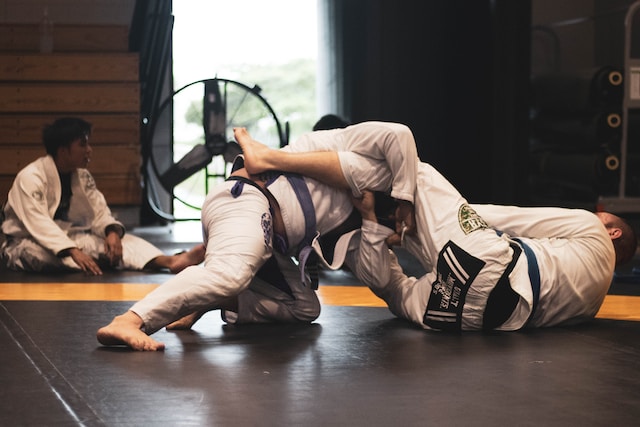
To execute the triangle choke, the attacker must first get into a position where they can wrap their legs around their opponent’s neck. Typically, this is done by pulling one of their opponent’s arms across their body and positioning themselves so that their opponent’s head is between their legs. From there, the attacker will use their legs to create a figure-four shape around their opponent’s neck, with one leg across the back of their opponent’s neck and the other leg across their opponent’s throat.
Once the attacker has locked in the triangle, they will use their hips to squeeze their opponent’s neck, cutting off the flow of blood to the brain. The attacker will also use their arms to help tighten the hold and prevent their opponent from escaping. The goal is to cause their opponent to lose consciousness or to force them to submit by tapping out.
The triangle choke is effective because it uses the attacker’s legs, which are typically stronger than their arms, to create a powerful and tight hold around the opponent’s neck. The triangular shape of the choke creates a lot of pressure on the opponent’s carotid arteries, which are the main blood vessels that supply blood to the brain. When these arteries are compressed, the flow of blood to the brain is reduced, and the opponent may feel dizzy or light-headed. Continued pressure can lead to unconsciousness, and if the choke is not released, it can cause serious injury or even death.
To avoid being caught in a triangle choke, fighters must be careful to maintain good posture and avoid allowing their opponent to wrap their legs around their neck. Fighters should also be aware of their opponent’s movements and look for signs that they may be setting up a triangle choke. Once a fighter is caught in the choke, the best way to escape is to create space between themselves and their opponent’s legs, either by pushing on their opponent’s legs or by twisting their body in a way that breaks the grip.
In conclusion, the triangle choke is a powerful submission hold that can be used to force an opponent to submit or to render them unconscious. The technique involves using one’s legs to create a triangular shape around the opponent’s neck, cutting off the flow of blood to the brain. The choke is effective because it uses the attacker’s legs, which are typically stronger than their arms, to create a tight and powerful hold. Fighters must be careful to avoid being caught in the choke and must be aware of their opponent’s movements and techniques. With proper technique and training, the triangle choke can be a powerful tool in a fighter’s arsenal, and a valuable addition to their submission repertoire.