The age of the moon has been a source of fascination for scientists for many years, and despite much research, there is still some uncertainty surrounding its exact age. However, the most widely accepted theory is that the moon formed approximately 4.5 billion years ago, shortly after the solar system’s formation.
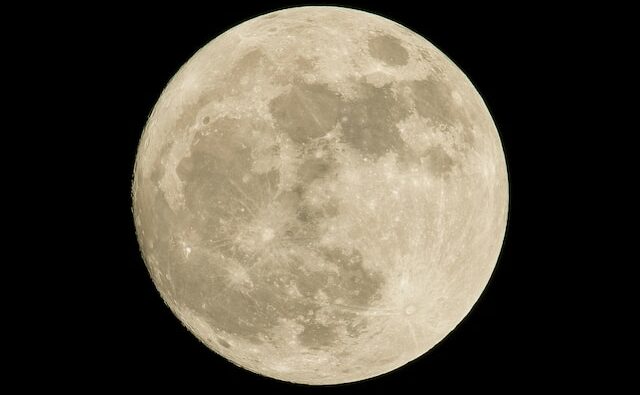
The Giant Impact Hypothesis is the leading theory on how the moon formed. According to this theory, a large body collided with the early Earth, resulting in debris being ejected into space. This debris eventually came together to form the moon. This theory is supported by the fact that the chemical composition of the moon’s rocks is similar to that of the Earth’s mantle.
Various methods have been used to estimate the age of the moon, including radiometric dating of moon rocks, analysis of lunar meteorites, and computer models of the moon’s formation. These methods have yielded slightly different estimates, but they all suggest that the moon is roughly the same age as the solar system.
Radiometric dating is a popular method used to date rocks, and it involves measuring the decay of isotopes in rocks to determine their age. Uranium-lead dating is the most commonly used method for dating lunar rocks. This method involves measuring the ratio of lead to uranium in a rock sample, and since uranium decays into lead at a known rate, scientists can use this ratio to calculate the age of the rock. This method has shown that the oldest lunar rocks are approximately 4.5 billion years old, which is consistent with the age of the solar system.
Apart from radiometric dating, scientists have also analyzed lunar craters to estimate the age of the moon. The moon’s surface is covered with countless craters caused by the impact of asteroids and other debris. By studying the size, density, and distribution of these craters, scientists can estimate the age of the moon’s surface. This method is not as precise as radiometric dating but still indicates that the moon is approximately 4.5 billion years old.
Another way of estimating the moon’s age is through computer modeling of its formation. Scientists can simulate the process of the Giant Impact Hypothesis and use the resulting models to estimate the moon’s age. These models take into account factors such as the size and composition of the colliding body and the impact velocity. While these models have produced slightly different estimates of the moon’s age, they generally suggest that the moon formed around 4.5 billion years ago.
It is important to note that the age of the moon is not the same as the age of the Earth. While the moon formed shortly after the solar system’s formation, the Earth is believed to be slightly older, with an estimated age of around 4.54 billion years.
In conclusion, although there is still some uncertainty surrounding the exact age of the moon, most scientists believe that it formed approximately 4.5 billion years ago, shortly after the formation of the solar system. This estimate is based on a variety of methods, including radiometric dating, lunar crater analysis, and computer modeling. While there may be slight variations in the estimates, they all suggest that the moon is approximately the same age as the solar system. The study of the moon’s age and formation continues to be an area of scientific research and interest, and ongoing studies may provide further insights into this intriguing celestial body.