A concave hexagon is a polygon with six sides that has at least one interior angle greater than 180 degrees, causing the shape to curve inward. In simpler terms, it is a hexagon with a “caved-in” or “indented” appearance.
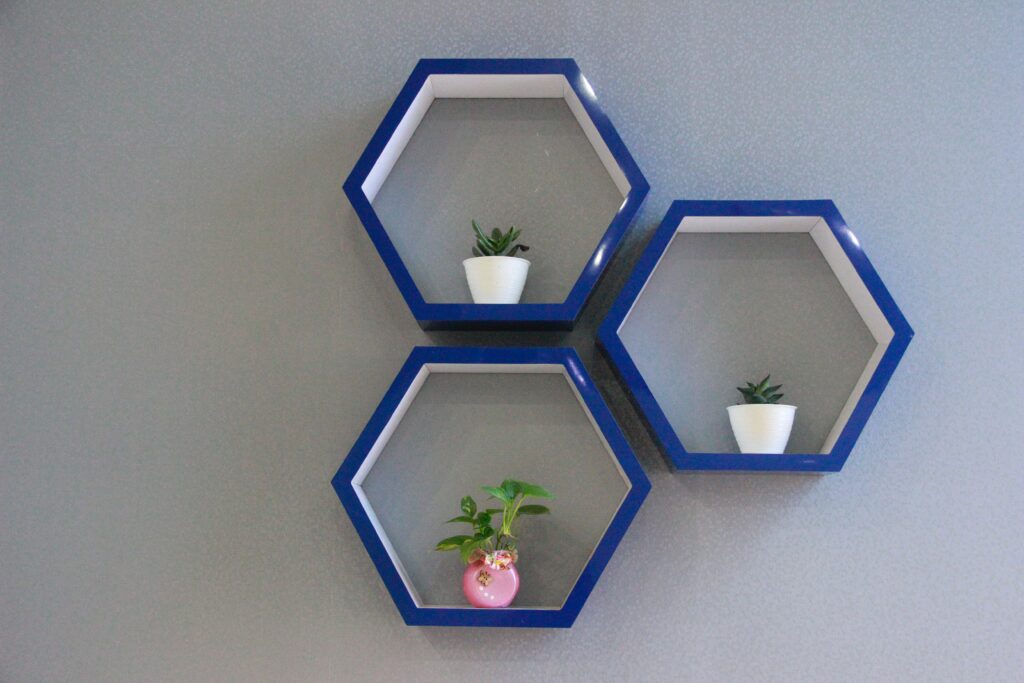
To better understand a concave hexagon, it’s essential to have a basic understanding of polygons and angles. A polygon is a two-dimensional shape with straight sides that are connected to form a closed figure. An angle is formed by two intersecting lines or sides of a polygon. It measures the amount of rotation between them. In a convex polygon, all interior angles are less than 180 degrees, and the sides of the polygon do not intersect. However, in a concave polygon, at least one interior angle is greater than 180 degrees, and the sides intersect, resulting in a “caved-in” or “concave” shape.
A hexagon is a polygon with six sides. In a regular hexagon, all sides and angles are equal. However, in a concave hexagon, at least one angle is greater than 180 degrees, causing the shape to curve inward. The indentation or concavity can occur at any of the six sides, resulting in different shapes and configurations. For example, one side may extend into the interior of the hexagon, creating an inward curve, while the other sides remain outwardly straight. Alternatively, multiple sides may curve inward, creating a more complex concave shape.
The properties and characteristics of a concave hexagon can be explored further. One important aspect is the interior angles of the hexagon. In a regular hexagon, each interior angle measures 120 degrees, as the sum of all interior angles in any hexagon. It is always 720 degrees (180 degrees multiplied by the number of sides minus two). However, in a concave hexagon, at least one interior angle will be greater than 180 degrees. This is because when the sides of the hexagon intersect. The angles formed by the intersection are larger than the angles in a convex hexagon where the sides do not intersect. The magnitude of the interior angles in a concave hexagon. Can vary depending on the specific configuration of the sides and the degree of concavity.
Another important aspect of a concave hexagon is its perimeter or the total length of its sides. Since the sides of a concave hexagon are not straight and may have curves, the perimeter can be challenging to calculate. In some cases, the perimeter may be larger than that of a convex hexagon with the same side lengths, as the indentation can add extra length to the sides. However, in other cases, the perimeter may be smaller due to the inward curving sides. The exact perimeter of a concave hexagon would depend on the specific shape and curvature of the sides.
It’s also worth noting that a concave hexagon is not a convex hexagon. In a convex hexagon, all interior angles are less than 180 degrees, and the sides do not intersect. The shape is “bulging” outward, and it has a more “flat” appearance compared to a concave hexagon. In contrast, a concave hexagon curves inward, creating a “caved-in” or “indented” appearance, and has at least one interior angle greater than 180 degrees. The distinction between convex and concave hexagons. It is an important concept in geometry and has practical implications in various mathematical applications and real-world scenarios.
Furthermore, concave hexagons are not commonly encountered in everyday life or in natural objects. In nature, most hexagons, such as honeycomb cells or snowflakes. They are typically regular or convex hexagons due to the natural tendency of objects to minimize energy and maintain structural stability.