Water is a ubiquitous compound on Earth and is essential for the existence of life as we know it. It is a colorless, odorless, and tasteless liquid that has a unique set of properties that make it an ideal solvent for biological and chemical reactions. Water’s unique properties, such as its high boiling point, surface tension, and density, are due to its covalent nature. In this essay, we will explore why water is covalent and what makes it such an important compound.
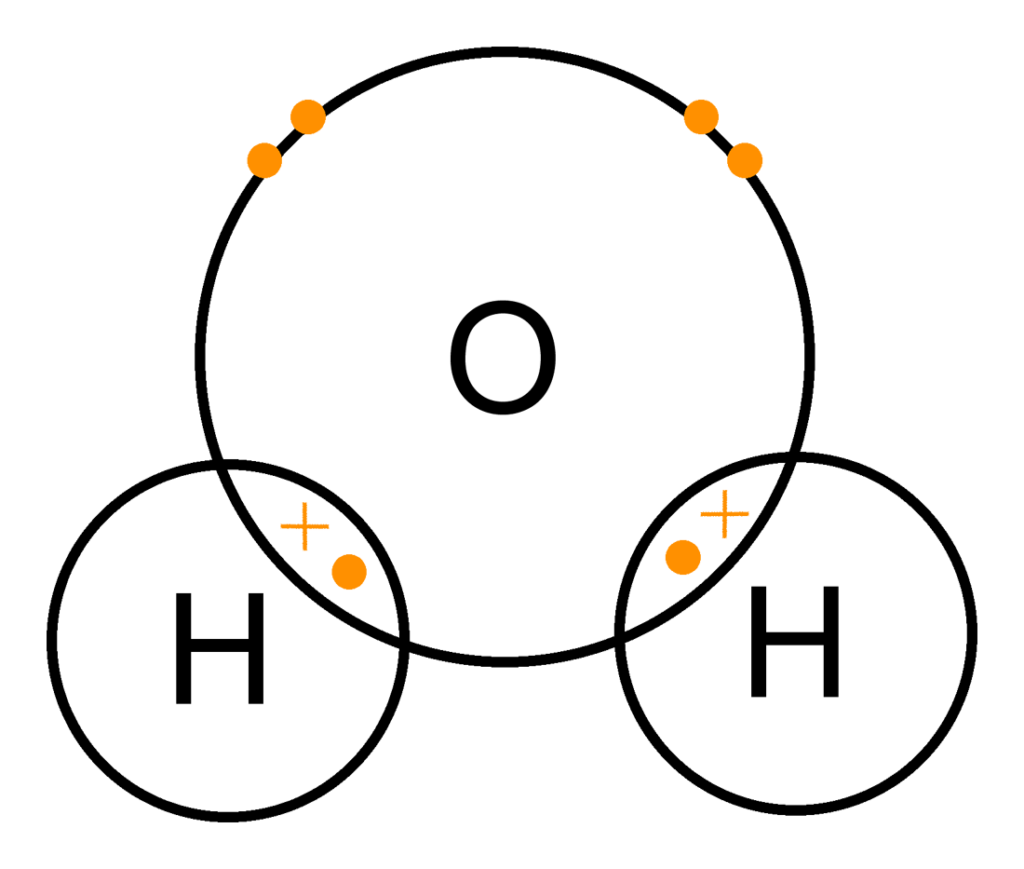
Covalent bonding is a type of chemical bonding in which two atoms share one or more pairs of electrons. In a covalent bond, the atoms share their valence electrons to achieve a stable electron configuration, which is the same as the nearest noble gas. Water, which has the chemical formula H2O, is a covalent compound composed of two hydrogen atoms and one oxygen atom.
The oxygen atom in water has six valence electrons, while each hydrogen atom has one valence electron. To achieve a stable electron configuration, the oxygen atom needs two more electrons, while each hydrogen atom needs one more electron. Therefore, the oxygen atom shares one electron with each hydrogen atom, forming a covalent bond.
The covalent bond in water is polar, which means that the electrons are not shared equally between the atoms. The oxygen atom has a higher electronegativity than the hydrogen atoms, which means that it attracts the shared electrons more strongly. As a result, the oxygen atom has a partial negative charge, while the hydrogen atoms have a partial positive charge. This unequal distribution of charges gives rise to a dipole moment, which makes water a polar molecule.
The polarity of water makes it an excellent solvent for polar molecules, such as salts, acids, and bases. The partial positive charge on the hydrogen atoms attracts the negative ions of salts, while the partial negative charge on the oxygen atom attracts the positive ions of salts. As a result, water molecules surround and dissolve the ions of salts, allowing them to dissociate and participate in chemical reactions.
Another unique property of water is its high boiling point. The boiling point of a liquid is the temperature at which its vapor pressure equals the external pressure. The boiling point of water is 100 degrees Celsius, which is much higher than other molecules of similar size and mass. The high boiling point of water is due to its strong intermolecular forces, which are caused by hydrogen bonding.
Hydrogen bonding is a type of intermolecular force that occurs between a hydrogen atom bonded to a highly electronegative atom, such as nitrogen, oxygen, or fluorine, and another electronegative atom in a nearby molecule. In water, the partially negative oxygen atom of one molecule attracts the partially positive hydrogen atom of another molecule, forming a hydrogen bond. These hydrogen bonds between water molecules make it more difficult to break the intermolecular forces, and thus, water has a high boiling point.
Water also has a high surface tension, which is the measure of the force required to break the surface of a liquid. The high surface tension of water is due to its cohesive forces, which are the attractive forces between the molecules of the same substance. In water, the cohesive forces are caused by hydrogen bonding between water molecules. As a result, water molecules at the surface of the liquid are pulled inward, creating a surface tension that allows some insects to walk on water.
In conclusion, water is covalent because it is composed of two hydrogen atoms and one oxygen atom that share electrons to achieve a stable electron configuration. The covalent bond in water is polar, which makes it a polar molecule that is an excellent solvent for polar molecules. Water also has a high boiling point and surface tension due to its strong intermolecular forces, such as