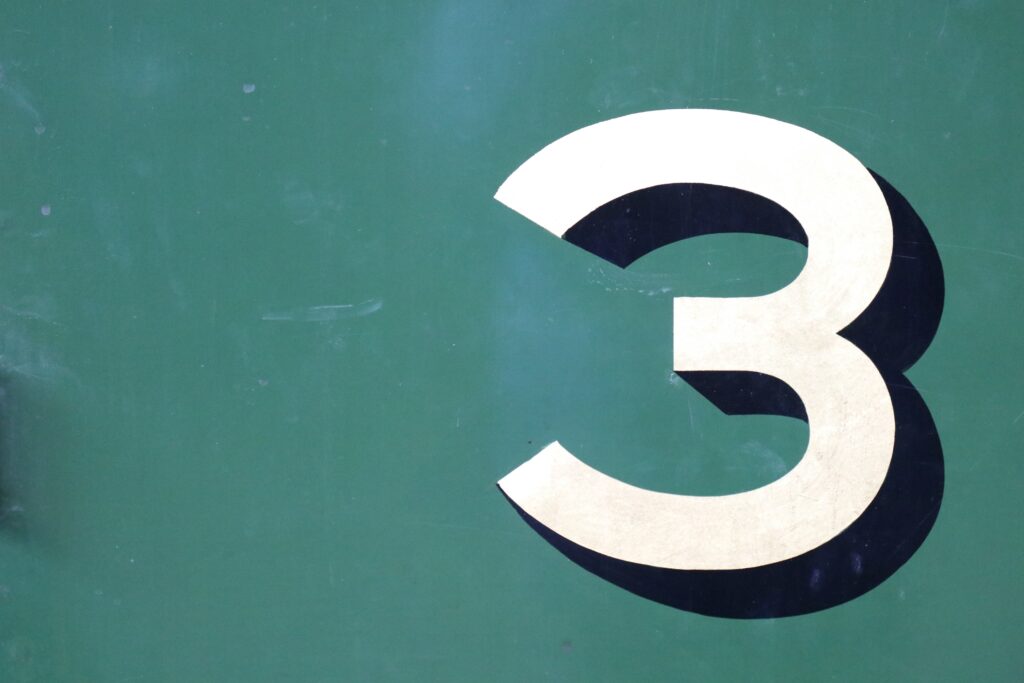
Throughout history, the number 3 has held great significance and has been a symbol of many concepts in different fields. In religion and mythology, the number 3 is often associated with a triad of deities or ideas. For example, Hinduism has three major deities, namely Brahma, Vishnu, and Shiva, who represent creation, preservation, and destruction, respectively. In Christianity, the Holy Trinity represents the unity of God as three distinct persons, namely God the Father, Jesus Christ, and the Holy Spirit. The number 3 also appears in other spiritual traditions, such as the three jewels of Buddhism and the three pillars of Islam.
In literature and storytelling, the number 3 is often used to create a sense of completeness or resolution. Many fairy tales follow a three-part structure, where the protagonist must overcome three challenges before achieving their goal. This structure creates a sense of progression and development as the protagonist faces increasingly difficult challenges before achieving their ultimate goal. The number 3 also appears in the three-act structure of plays and movies, where the story is divided into three parts: setup, confrontation, and resolution.
In psychology and cognitive science, the number 3 has been found to be significant in various ways. Human memory has a capacity of around 3 to 7 items, known as the “magical number 7”. This means that people can remember around 3 to 7 pieces of information in their short-term memory at any given time. Additionally, the number 3 has been found to be significant in visual perception, as the human eye tends to group objects into threes, known as the “rule of thirds”. This rule suggests that images are more visually appealing when the main subject is placed at one of the intersection points of an imaginary grid divided into thirds.
In art and design, the number 3 is often used to create balance and harmony. For example, the rule of thirds is often used in photography and graphic design to create visually appealing compositions. The color wheel, which is used to create harmonious color schemes, is based on the three primary colors and their complementary colors. In architecture, the number 3 is often used in the design of facades, where a three-part composition of base, middle, and top creates a sense of balance and proportion.
In music, the number 3 is significant in various ways. There are three main elements of music: rhythm, melody, and harmony. Additionally, many musical forms are based on the three-part structure, such as the sonata form. The three-chord progression is a common and simple chord progression used in many songs, and the three-minute song length has been found to be a popular and successful length for radio play.
In sports, the number 3 is often significant. In many team sports, three points are awarded for scoring a goal or making a shot from beyond a certain distance. Additionally, in many individual sports, such as gymnastics and figure skating, competitors must perform three routines or attempts.